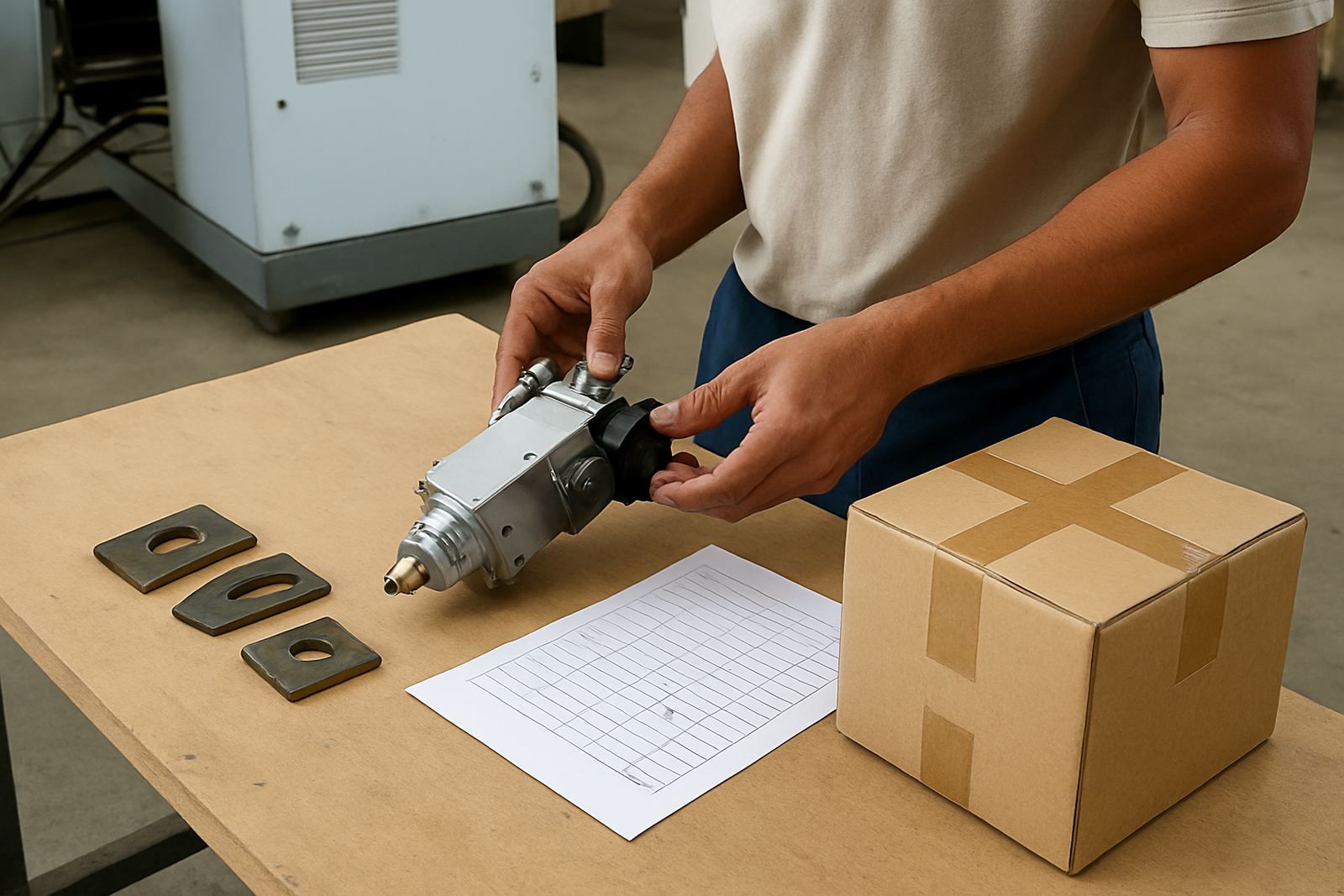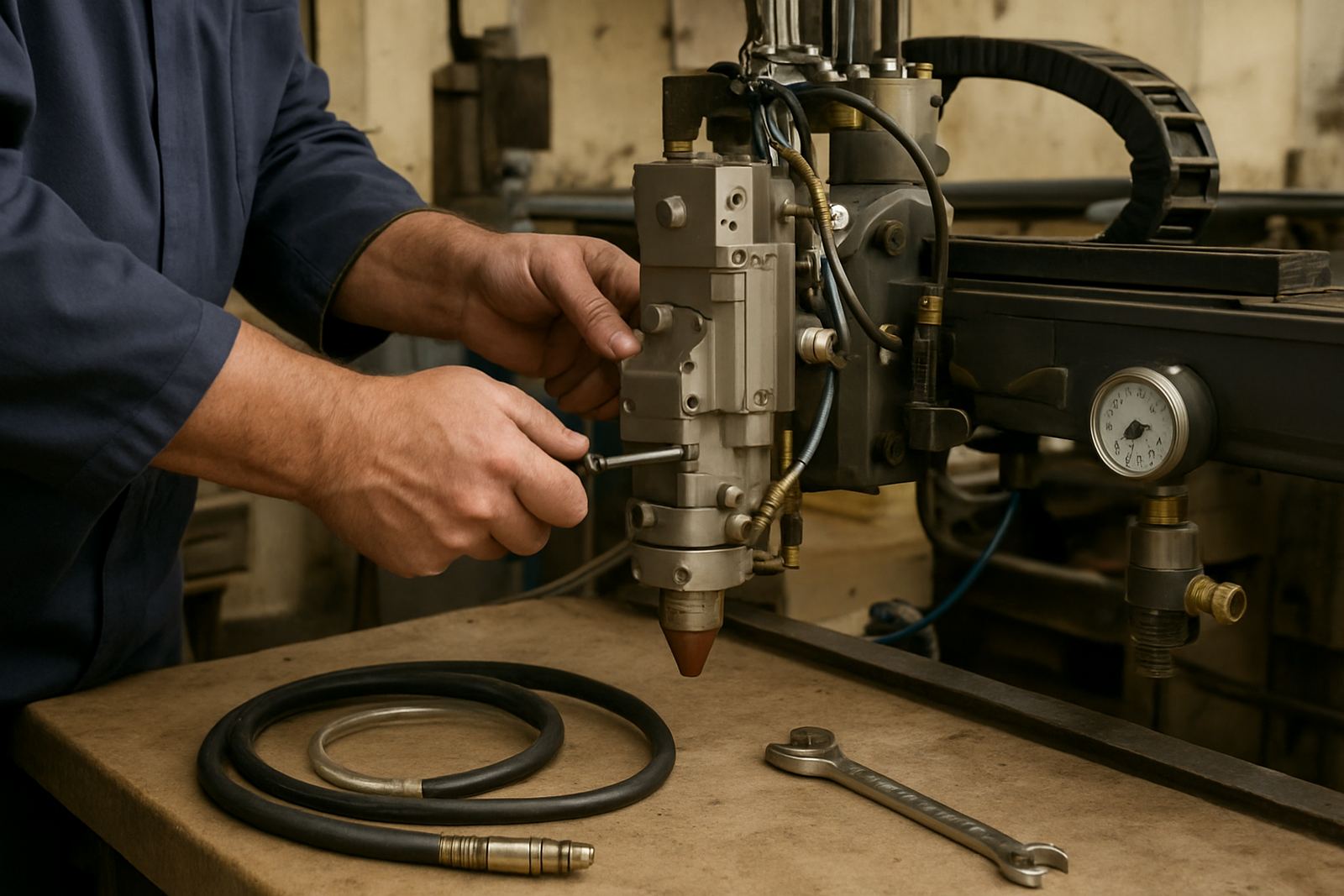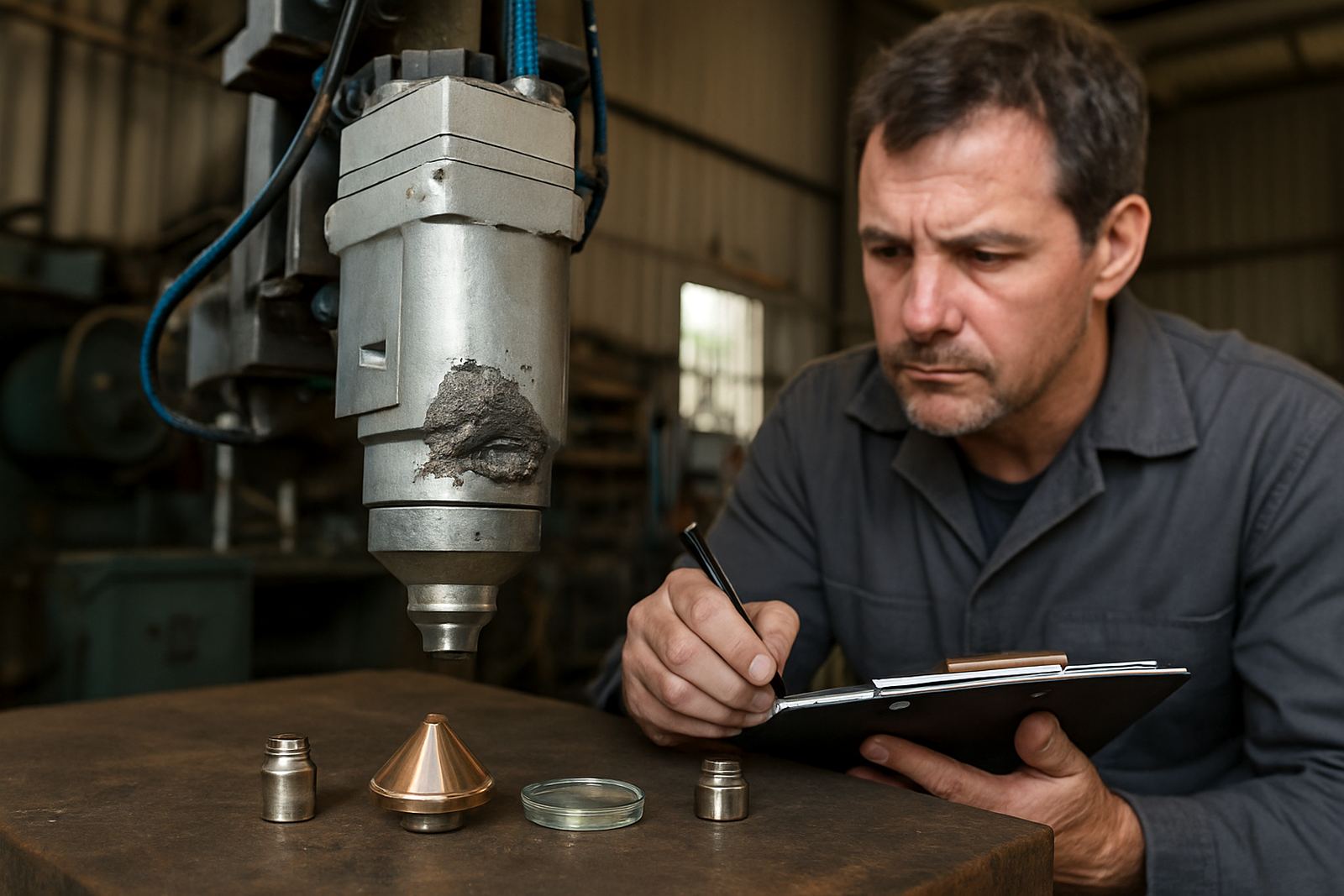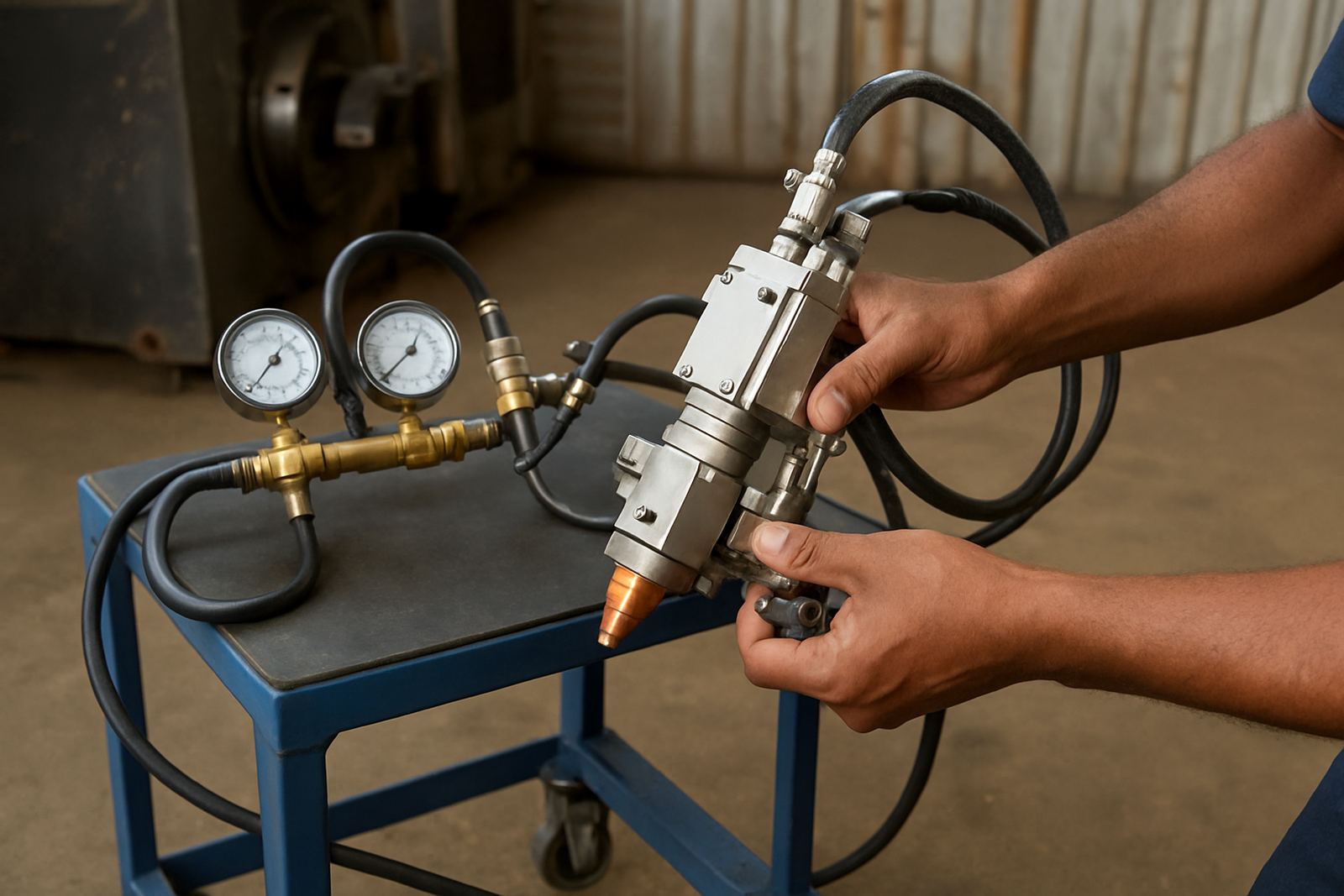
What the bench pressure test confirms
This service is done after repair, cleaning or parts replacement to prove the head is holding pressure where it should. We test the gas path, seals, ceramic holder area, nozzle seat and internal passages for leaks, pressure drop and irregular flow that can affect cut quality. If a head has taken a knock, or if a workshop has had repeated nozzle burn marks and poor edge finish, this test helps show whether the issue is still inside the head or has already been corrected.
The bench setup is used for fibre and CO2 cutting heads, with the aim of catching problems before the head is refitted to a machine. We also look for signs of moisture, oil or debris that could affect cutting, so the unit does not return with a hidden fault. That saves time on the floor and keeps the machine from being pulled apart twice.
How we pressure test a cutting head
The process starts with a visual inspection and a record of the repair history. We then connect the head to the bench test rig, isolate the gas path and bring the pressure up in controlled stages. Once the set pressure is reached, we watch for pressure fall-off, hissing points and unstable readings. Any problem gets traced before the head is signed off.
- Incoming condition check and fault note
- Bench connection and seal verification
- Controlled pressure increase to test level
- Leak detection and pressure hold observation
- Final clean, sign-off and return notes
If the unit fails hold test, we do not send it out half-fixed. We strip it back for further diagnosis, then re-test after the fault is corrected. That extra step matters on busy plants in Boksburg, Germiston and Kempton Park where one weak head can stall a whole cutting shift.
Pressure ranges and test conditions we work to
Test values depend on the head type, seal arrangement and the machine maker's operating setup. In practice, we work within the pressure band required for the specific cutting application and confirm a stable hold under bench conditions. The aim is not just to reach a number, but to prove the assembly can keep that pressure steady without bleed-down.
Our bench work is suited to local workshop conditions, including load-shedding interruptions and dusty factory environments where a head may come in with dirt around the nozzle body. We keep the test method practical and repeatable, with pressure readings that can be compared before and after repair. Where needed, we check the head again after a short soak period to make sure the result is consistent.
- Suitable for repaired heads that need final verification
- Useful after collision damage, seal change or internal cleaning
- Helps confirm gas integrity before reinstalling the unit
- Can form part of a wider return-to-service checklist
When a bench test is worth doing
A pressure test is worthwhile any time the cutting head has been opened up, repaired or suspected of leaking. It is also sensible after a nozzle seat restoration, lens replacement, window replacement or ceramic holder change. If the machine has been throwing cut inconsistencies, repeated pierce faults or rough edges after a service, the bench test helps rule out gas leakage before the head goes back on the gantry.
For job shops and signage plants working to deadlines, this service is often the difference between a quick return and a wasted installation. It is especially useful for fabricators running mixed material jobs, where mild steel, stainless and aluminium all need stable gas delivery. A head that fails on the bench is far cheaper to sort here than on a live production line.
Turnaround time and service coverage
Turnaround depends on the condition of the head and whether extra repair is needed before the test can pass. Straightforward bench pressure tests are usually handled quickly, while units with damaged seals, warped parts or contamination may take longer. We keep the process moving so downtime stays short, whether the head comes in from Johannesburg, Pretoria, Vanderbijlpark, Durban or Cape Town.
Customers can bring units to our Boksburg base or book on-site support where practical. For plants that cannot afford a long stop, we coordinate intake, testing and collection with the service team so the job does not sit on the side for days. If the head is being tested as part of a larger repair, the pressure check is done before return to site so you are not guessing later.
- Boksburg workshop testing for bench-in units
- On-site support where the machine and production plan allow it
- Works for fibre and CO2 laser heads
- Suitable for single heads and repeat workshop batches
Pricing approach and maintenance intervals
Pricing is based on the head type, the condition on arrival and whether the test is a stand-alone check or part of a repair. A clean head that only needs final verification will cost less than one that must be stripped, resealed and rechecked. We quote after inspection, so you know what is needed before work continues.
For maintenance, we recommend a pressure test after any collision, after internal cleaning, and whenever cut quality shows signs of gas instability. In busy fabrication shops, a scheduled check every 6 to 12 months is sensible, especially where heads are run hard, exposed to dust or used across long shifts. In coastal areas like Durban, more frequent inspection can help where moisture and airborne grime are a problem.
Regular testing also helps catch slow leaks before they turn into burnt consumables, poor piercing or a repeat callout. It is a simple step, but it often saves a lot of wasted plate and rework.
What you receive after the test
After the bench pressure test, we issue a clear service result showing whether the head held pressure, where any loss was found and what was corrected. If the unit passes, it can return to service with better confidence. If it fails, you get a practical fault note and next-step recommendation, so the repair path is clear.
That final sign-off is useful for workshops that need record keeping for repeated machine faults or internal maintenance planning. It also helps service teams explain to operators why a head was held back instead of being rushed back into production. In short, it is a small check with a big effect on uptime.
Key facts
| Service type | Bench pressure test for repaired laser cutting heads |
|---|---|
| Head types | Fibre and CO2 laser cutting heads |
| Test purpose | Confirm gas integrity and pressure hold after repair |
| Typical checks | Leak detection, pressure stability, seal condition, gas path integrity |
| Coverage area | Boksburg, Johannesburg, Pretoria, Vanderbijlpark, Durban, Cape Town and nearby industrial areas |
| Booking method | Enquiry form on the contact page |