What a Collimation Unit Does in a Laser Head
The collimation unit sits inside the cutting head and helps turn the incoming beam into a parallel path before it reaches the focusing section. When it is clean and correctly aligned, the machine cuts cleaner edges, pierces more consistently, and keeps the beam centred through the head.
Once the unit is knocked out of alignment, or dust and oil vapour build up inside it, the machine can start showing flare at the kerf, rough edges, excess dross, unstable piercing and repeated lens failures. On fibre systems, even a small internal issue can cause a costly slowdown. On CO2 systems, contamination often shows up as loss of cutting power and poor beam quality.
When Collimation Repair Makes Sense
This service suits heads that have taken a knock, been fitted with the wrong consumables, or started to drift after normal wear. It is also used where internal contamination has entered through a damaged seal, a cracked window, or poor gas quality. We see this often on job shops and fabrication plants working long shifts, especially where dust, moisture and power interruptions put extra strain on the machine.
- Beam no longer stays centred through the head
- Visible contamination on internal optics or holder surfaces
- Cut quality has dropped after a collision
- Machine alarms on temperature, focus or head position
- Repeated nozzle wear or unstable pierce results
If the unit is still structurally sound, repair is usually better value than full replacement. If the optics carrier, housing or threads are badly damaged, we will advise that upfront so the workshop can plan properly.
Sizes, Head Types and Repair Options
We repair collimation assemblies used on common fibre and CO2 laser cutting heads across workshop and production machines. Each unit is checked for compatibility, lens seat condition, retaining surfaces and internal cleanliness before any parts are fitted. The right repair depends on the beam diameter, lens format and the body condition, not just the make of the machine.
Typical options include standard service for light contamination, precision cleaning after internal dust ingress, and full strip and rebuild where alignment has moved or parts have been damaged. Some assemblies only need a new lens and seal set, while others need the internal carrier re-set and tested on the bench.
- Fibre laser collimation units for light, medium and higher power cutters
- CO2 laser collimation assemblies for tube and mixed production systems
- Units with standard lens formats and matched retaining hardware
- Repair for heads used on flatbed cutters, signage equipment and fabrication lines
Installation Conditions, Power and Gas Needs
Collimation repair does not need special site power during the repair itself, but the machine it serves should have stable electrical supply when it goes back into production. In South Africa, load-shedding and poor voltage can cause extra wear on servos, cooling and beam stability, so the full system should be checked before the head is returned to service.
Clean dry assist gas matters as much as the optics. Oil, water and scale in the gas line will shorten the life of a repaired collimation unit, even if the optics were fitted correctly. We recommend checking filter condition, regulator stability and the gas line for leaks before the head is installed again.
- Stable mains supply or correctly managed backup power
- Dry, filtered assist gas at the correct pressure for the job
- Clean head environment, free from cutting dust and oil mist
- Cooling system working within spec and not running hot
How We Repair and Test the Assembly
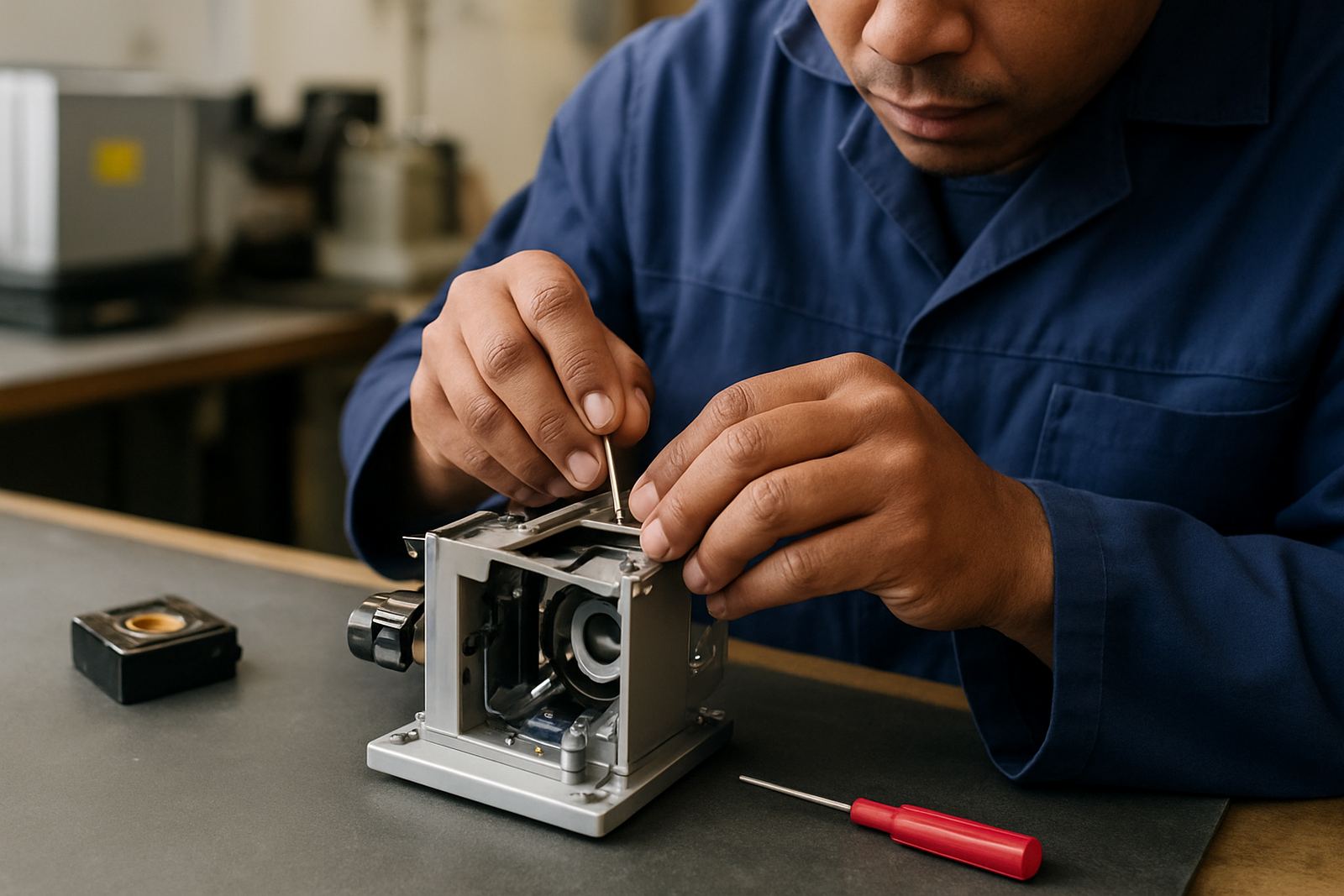
Each unit is stripped, inspected and cleaned on the bench. We check for cracks, burnt marks, seat damage, loose threads and contamination that may have moved deeper into the assembly. If a collision has distorted the internal path, we correct the parts that can still be recovered and replace the items that cannot hold alignment properly.
After the repair, the unit is tested for fit, beam path condition and pressure response where required. We also carry out a return to service check so the workshop gets a part that is ready for use, not just cleaned and sent back. On site work is available where the head cannot be removed quickly, and bench repair is often the better choice for a badly contaminated unit.
- Strip and inspection
- Internal cleaning and contamination removal
- Lens replacement and seal renewal
- Alignment check and bench pressure test
- Return to service test before handover
Care, Servicing and What to Check When Ordering
For the best service life, keep the cutting head clean, replace damaged consumables early, and avoid running with poor gas quality. If the machine has already suffered a collision, do not keep cutting with it in the hope the fault will clear itself. That usually makes the damage worse and can push debris deeper into the optics path.
When ordering a repair, send the head model, machine type, beam power, fault symptoms and clear photos of the damaged area. If you have the old lens, nozzle or window, include that as well. The more detail we get, the quicker the right parts can be matched and the less time the machine sits idle, which matters when there is a deadline to meet.
- Head model and machine type
- Fibre or CO2 system
- Laser power rating in kilowatts or watts
- Fault description and recent collision history
- Photos of labels, lens seat and damaged surfaces
Support in Boksburg and Across South Africa
Laser Ray Tools supports workshops and fabricators from Boksburg, Ekurhuleni, with service coverage for Johannesburg, Pretoria, Vanderbijlpark, Durban and Cape Town. We also assist clients in Germiston and Kempton Park when heads need quick attention or a bench repair is more practical than waiting for a full machine stop.
Our team works on fibre and CO2 cutting heads for signage plants, job shops and metal fabricators that need uptime to stay on schedule. Clients reach us through the enquiry form on our contact page, and we will advise whether the unit should come in for bench repair or be attended to on site.
Key facts
| Service Type | Collimation unit repair, cleaning, alignment check and parts replacement |
|---|---|
| Compatible Systems | Fibre laser and CO2 laser cutting heads |
| Typical Faults | Misalignment, internal contamination, damaged lens seat, collision damage |
| Repair Method | Bench strip and inspection, with on-site support where practical |
| Testing | Pressure test, alignment check and return to service test |
| Service Area | Boksburg, Johannesburg, Pretoria, Vanderbijlpark, Durban, Cape Town and surrounding areas |