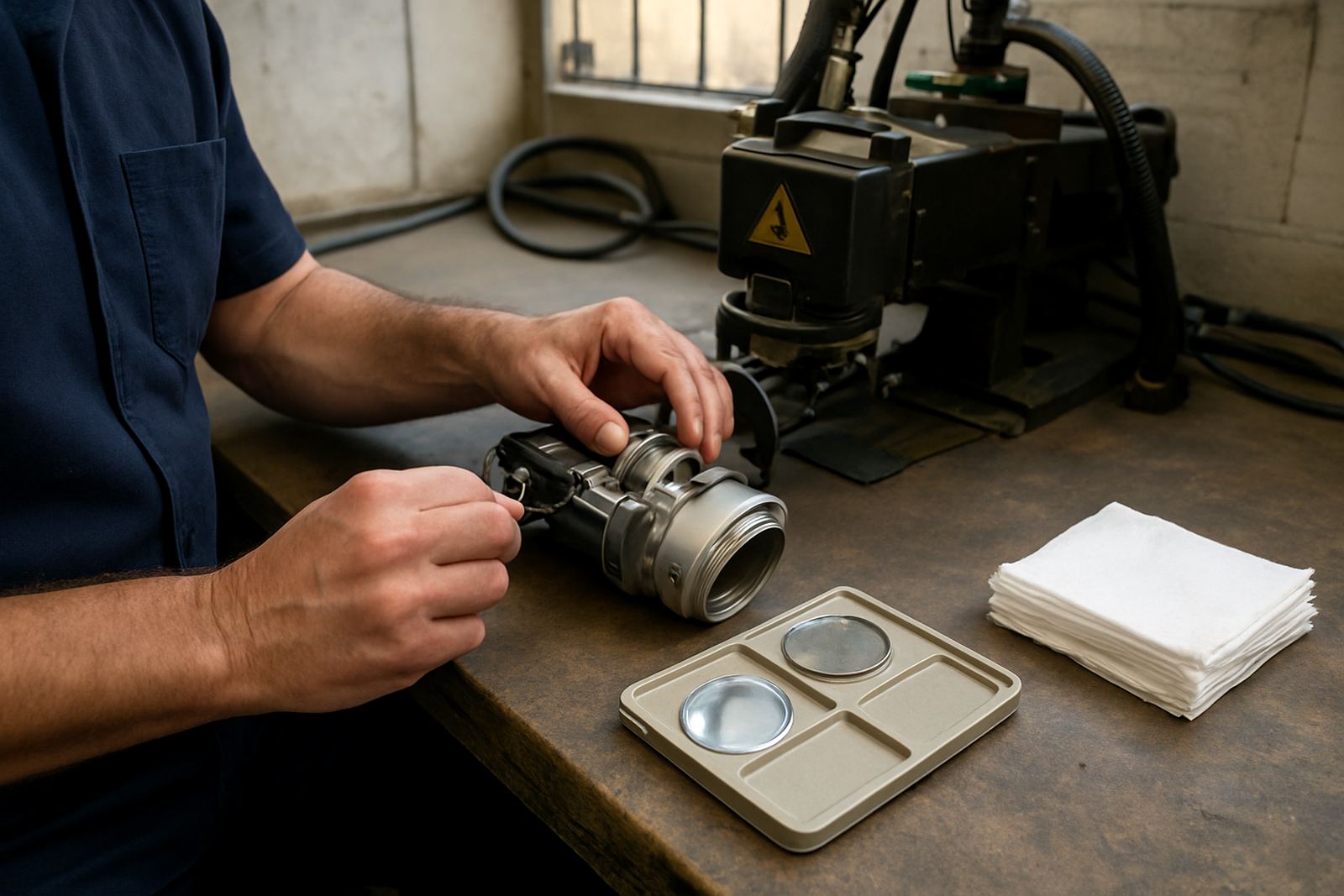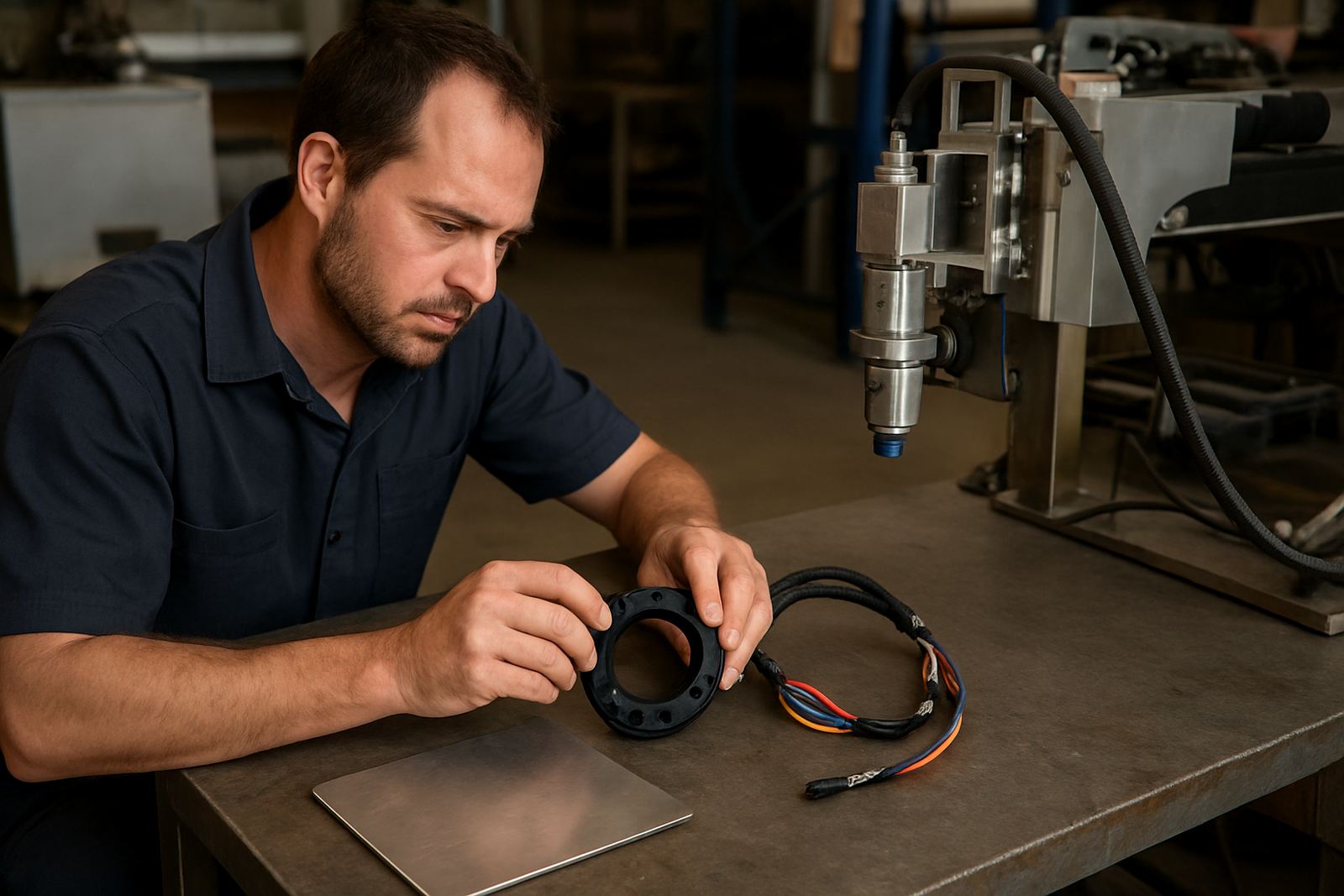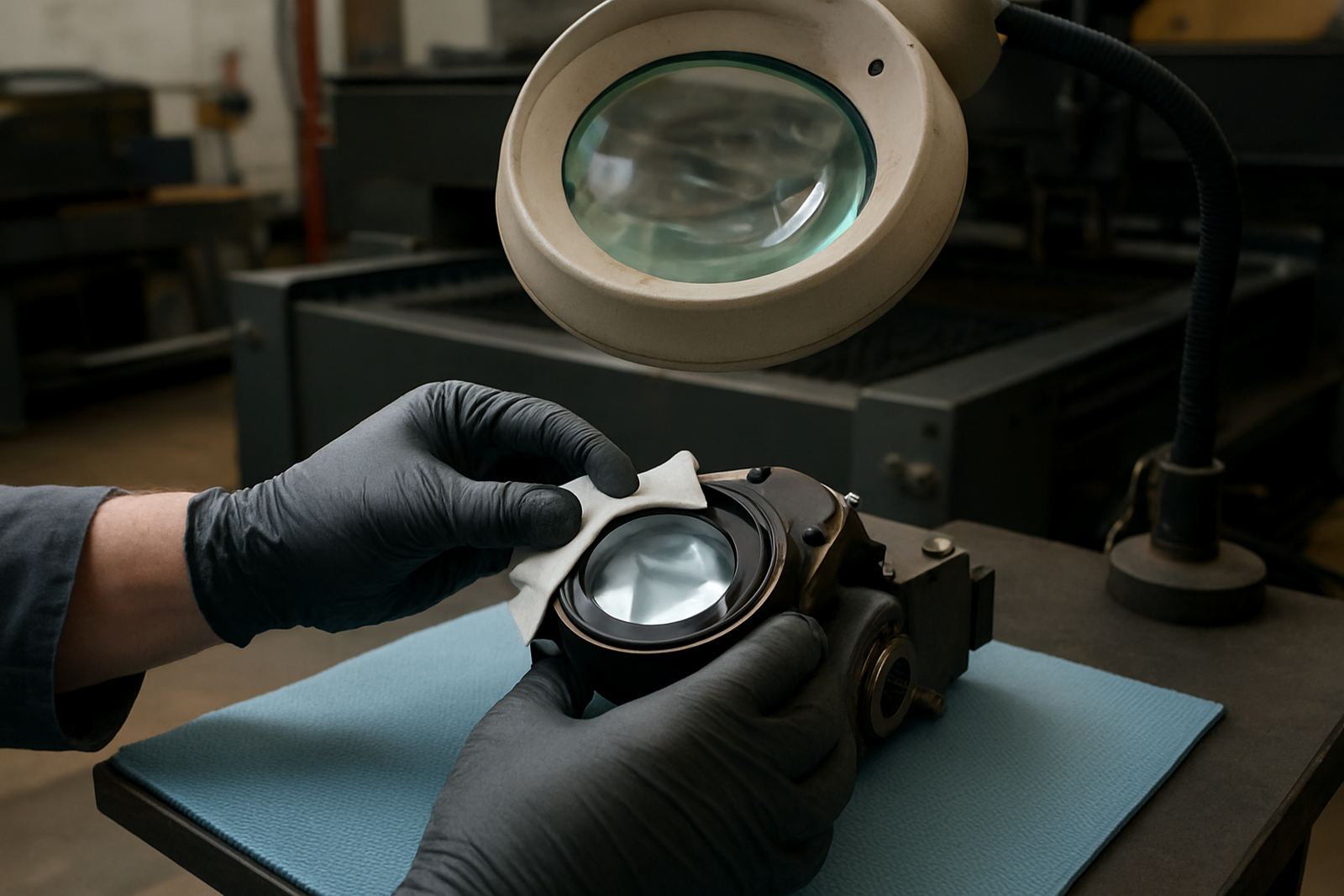
What The Optics Cleaning Service Covers
This service is for laser cutting heads and optical sections that are still mechanically sound, but are losing performance because of contamination. In a busy workshop, fine metal dust, oil mist, fume residue and moisture can settle on lenses, protective windows, sensor faces and nearby seats. Once that build-up starts, you may see rough edges, more dross, unstable pierce quality or repeated alarms on the machine.
Our team removes accessible contamination carefully and checks the parts around the optical path for heat marks, scratches, loose rings and signs of blowback. The aim is not a quick wipe and hope, but a proper clean that gives the machine a fair chance to run again. If a component is damaged, we will say so before refitting it, rather than putting a worn part back in service.
- Suitable for fibre and CO2 laser cutting heads
- Targets accessible lenses, windows, holders and seats
- Helps when cut quality drops without a major crash
- Can be combined with strip and inspection work
Where It Suits Best In A Production Shop
Optics cleaning is useful for job shops, signage plants, fabrication yards and light to medium production lines that run daily and cannot afford long stoppages. It is especially helpful after dusty cutting runs, humid coastal storage, or when compressed air quality has not been ideal. In Durban and Cape Town, for example, moisture and airborne contamination can make a clean head dirty again faster than expected.
This service suits machines that are still cutting, but not cutting well enough for consistent work. If the head has had a collision, a damaged nozzle seat or a cracked lens, optics cleaning alone will not fix it. In that case we may combine the clean with collision damage repair, nozzle seat restoration, lens replacement, window replacement or head alignment checks. That keeps the job practical, not over-sold.
- Job shops with changing material thicknesses
- Signage and light engineering plants
- Fabricators working mild steel, stainless steel and aluminium
- Sites where load-shedding and stop-start production affect cleanliness and setup
What Is Cleaned And Checked During The Service
We focus on the optical parts and nearby items that directly affect beam quality and cut stability. Each unit is handled on the bench where possible, with controlled cleaning methods and careful inspection under good light. We do not force anything that should be replaced, and we check seating faces so the next lens or window is not compromised by a damaged contact point.
Depending on the head type and condition, the service can include cleaning of accessible lenses, protective windows, ceramic holders, sensor rings and internal passages that carry dust or debris. If the machine is due for it, we can also check gas path condition, alignment and return-to-service status after reassembly.
- Accessible lens and window cleaning
- Sensor ring and ceramic holder inspection
- Seat and housing cleanliness check
- Basic alignment and re-fit inspection
Sizes, Options And Machine Types
Laser Ray Tools services a range of fibre and CO2 cutting heads used on sheet metal and profile cutting systems. The service is not sold as a one-size job, because different heads use different lens diameters, window formats and internal layouts. What we do is assess the machine first, then clean the correct parts for that specific head and application.
Options usually depend on whether the unit stays on the machine, comes to the Boksburg workshop, or needs field support at your site. For some customers, a bench clean is best because it allows fuller inspection and pressure testing. For others, an on-site visit is better when the machine is large, the head is awkward to remove, or production needs a quick turn around.
- Bench cleaning for removable cutting heads
- On-site cleaning for selected machine setups
- Partial clean after routine contamination
- Combined clean and repair after a minor collision
Installation, Power And Gas Requirements
This service does not need a special installation in the way a new machine might, but the cutting system must be safe to isolate and access. We need a clean working area, suitable tools for removal where required, and a stable place to inspect the head. If the machine is still under production pressure, make sure the operator can shut down safely and the service area is clear of scrap and loose consumables.
Power and gas requirements depend on the machine and the test we are carrying out. The cutter should be properly isolated before any strip or cleaning work starts. If we are completing a pressure test or return-to-service test, the relevant assist gas, cooling and electrical systems must be available and functioning. Poor air quality, low gas pressure or unstable cooling can make a cleaned head perform badly, so those items should be checked at the same time.
- Safe isolation of the laser machine before work starts
- Access to the cutting head and surrounding service points
- Clean, dry compressed air where the setup requires it
- Cooling and assist gas systems ready for test and restart
Care, Servicing And When To Book Again
Cleaning optical parts is only one part of keeping a laser machine in shape. To avoid repeat contamination, operators should keep the area around the head free of dust build-up, wipe down exposed surfaces and watch for signs that spatter is reaching the nozzle or window. In workshops with heavy use, optics may need attention more often than the service schedule on paper suggests.
After a cleaning service, keep an eye on cut consistency over the next few shifts. If the same symptoms return quickly, there may be a deeper issue such as gas path contamination, damaged seals, poor air quality, a worn nozzle seat or a head that has shifted after impact. That is where our broader service range helps, because we can move from cleaning into diagnosis without wasting time.
- Check for recurring residue after long cutting runs
- Watch for edge roughness, flare marks and unstable piercing
- Inspect filters, air supply and cooling quality regularly
- Book follow-up service sooner on humid or dusty sites
What To Check Before You Send A Head Or Book Site Support
Before ordering, note the machine type, cutting head model if available, and what symptoms you are seeing. It helps to know whether the problem is gradual loss of cut quality, a recent crash, repeated alarms, or visible contamination on the window or lens. Give us the material type, thickness range and how often the machine is running, because those details help us judge whether optics cleaning alone is enough.
If the unit is being sent to our Boksburg workshop, package it to prevent dust and impact damage during transport. If you need on-site support in Johannesburg, Pretoria, Vanderbijlpark, Germiston, Kempton Park, Durban or Cape Town, make sure we can reach the machine safely and that the operator knows where the issue began. That saves time on arrival and keeps the job focused on the real fault.
- Machine make and head type, if known
- Symptoms, alarms and cut quality changes
- Material types and thicknesses being run
- Whether the head has had a crash or heavy contamination
Key facts
| Service type | Optics cleaning for accessible laser cutting head components |
|---|---|
| Machine compatibility | Fibre laser and CO2 laser systems |
| Typical use | Dust, smoke residue, spatter and moisture contamination |
| Service mode | Bench repair, on-site repair, or combined inspection |
| Related checks | Nozzle seat, lens, window, sensor ring, gas path and alignment |
| Coverage | Boksburg base with support across South Africa |