When kitchen shop production starts slipping
Kitchen equipment workshops work to tight drawings and even tighter delivery dates. A corner that is out by a millimetre can throw off a full stainless counter run, so when a laser starts leaving dross, losing focus or marking the sheet, the whole job queue feels it. We repair fibre and CO2 laser machines and cutting heads for shops making counters, cabinets, splashbacks and food service fittings across Gauteng, KwaZulu-Natal, the Western Cape and the Vaal.
Many call us after a head collision, repeated nozzle strikes or a slow decline in cut quality. Others notice the machine is still running, but the edges are rough and the assist gas is wasting money. Our work is practical: diagnose the fault, strip and inspect the head, replace worn parts, check alignment and test the unit before it goes back into service.
Typical equipment in a kitchen fabrication shop
Most kitchen equipment shops use laser systems on stainless steel, mild steel and sometimes aluminium for trim pieces and frames. The usual set-up includes a sheet bed, extraction, assist gas, the cutting machine and a cutting head that must stay clean and true. If the head is off centre, or the ceramic holder has cracked, the machine can still move but the cut quality falls away quickly.
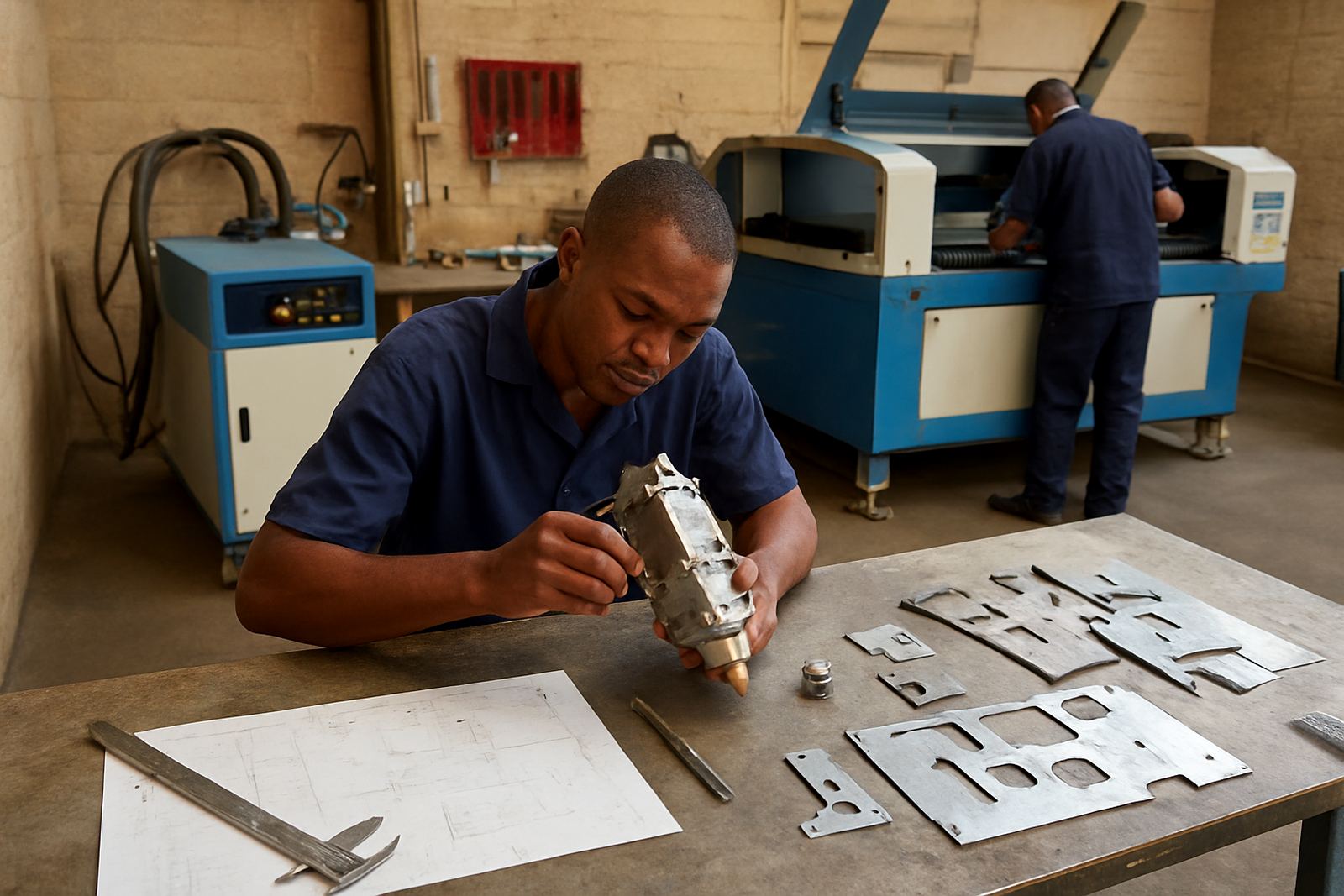
Common parts we see in workshop repairs include lenses, protective windows, nozzles, sensor rings and ceramic holders. We also service the gas path and do a pressure test where required, especially on machines that have been running long shifts through load-shedding recoveries and back-to-back jobs.
- Fibre lasers cutting 1 mm to 6 mm stainless for sinks, doors and panels
- CO2 systems still used in some older fabrication shops for lighter sheet work
- Cutting heads that need lens replacement after heat marks or contamination
- Machines that need a return to service test after collision damage
- Workshop units that need bench repair before they go back into the line
Layout and planning advice for cleaner cutting
For kitchen equipment makers, the best layout is not only about where the machine sits. It is about keeping sheet flow, offcut handling and finished parts moving without knocks and contamination. A laser placed too close to grinding, polishing or welding areas will pick up dust and metal fines, and that shortens the life of the windows and lenses. In coastal towns like Durban and Cape Town, humidity adds another layer, so storage for spares and optics must stay dry and sealed.
We often advise shops to keep a small service zone near the laser, with clear space for lens checks, nozzle changes and head inspection. The machine should have enough room for operators to load 3 metre sheets safely, and the floor should stay level to avoid vibration. On busy sites in Johannesburg, Pretoria or Boksburg, a tidy path between the material rack and the cutter saves more time than people expect.
- Keep stainless sheet storage off the floor and away from splash zones
- Separate grinding and welding bays from the laser area where possible
- Plan for safe access to the cutting head during maintenance
- Allow space for gas bottles, extraction ducting and the control cabinet
- Use covered storage for optics and consumables in humid or dusty sites
Common mistakes that cost a kitchen shop time and money
One of the biggest mistakes is waiting until the cut quality is completely gone before calling for service. By then the nozzle seat may be worn, the lens may be heat stressed and the head can already be out of alignment. Another common issue is trying to keep the machine going with cheap parts that do not match the head properly. That usually brings the fault back faster than expected.
We also see shops skip simple checks after a collision. A head can look fine from the outside, but a slight bend inside the body can cause repeated cutting errors, gas leaks or a poor pressure reading. If the machine has had a crash or a hard touch-off, a proper strip and inspection is the safer route.
- Running with a damaged nozzle instead of replacing it early
- Ignoring marks on the protective window until the beam quality drops
- Using the wrong cleaning method on optics and sensor parts
- Skipping alignment checks after a head strike
- Keeping the machine in service with unstable gas delivery
What repair work usually involves
For kitchen equipment shops, repair work depends on whether the problem is in the head or in the machine itself. Our service can include strip and inspection, collision damage repair, nozzle seat restoration, lens replacement, window replacement, sensor ring service, ceramic holder change, internal cleaning, gas path service, head alignment check, bench pressure test and return to service testing. If the unit must come off the line, we handle bench work in Boksburg and field support on site where the job cannot wait.
Before a part is changed, we check the symptom against the machine history and the cutting material. Stainless steel work often shows problems quickly because the process is less forgiving than mild steel. We aim to fix the fault properly the first time so the shop can get back to cabinet sides, sink cut-outs and framed panels without repeat stoppages.
Budget ranges for kitchen equipment workshops
Repair budgets depend on the make of the head, the extent of the damage and whether the issue is a simple wear item or a full collision repair. A basic service on a cutting head may fall in the lower thousands of Rand, while more involved repair work with multiple parts can move into the mid-thousands or higher. If the machine needs a bench pressure test, additional alignment or return to service testing, that adds to the total.
For planning purposes, many workshops set aside a monthly maintenance amount rather than waiting for a full breakdown. A sensible allowance for a busy kitchen fabrication shop is often between R3 000 and R15 000 a month, depending on machine age, shift pattern and how often heads, lenses and nozzles need replacing. A collision repair can cost more than routine wear items, so it pays to keep a small spares buffer on hand. Even a missing comma in production notes can slow a job, so clear service records matter too.
- Routine consumables: lower hundreds to low thousands of Rand
- Head service with inspection and cleaning: mid-thousands of Rand
- Collision damage repair with parts: often several thousand Rand more
- On-site callout and testing: priced according to location and fault